“Couldn’t we just hold all of this in our PLM?”
It is the question we hear most often from quality and IT teams, and it is fair. If your Product Lifecycle Management (PLM) system already holds specifications, bills of materials, suppliers, and purchase orders, why should inspections and lab tests live anywhere else?
Because they do different kinds of work. PLM holds the plan: what the product should be, what it should cost, who should make it. Quality management deals with what happened: an inspection that failed in a factory you do not own, a lab result out of spec, a call on whether the order ships. One system records decisions, and the other has to get them made, by people who do not work for you, before the shipment leaves.
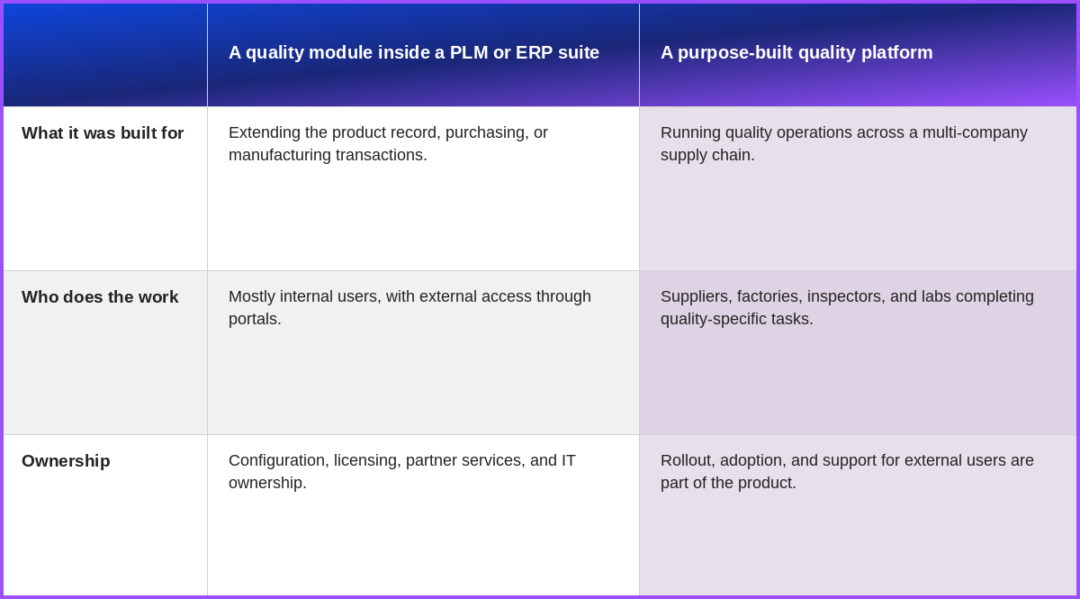
What PLM and ERP platforms are built for
PLM software connects the information and processes involved in taking a product from concept to consumer. It governs specifications, bills of materials, costs, and approvals as a product moves from design into sourcing. Enterprise Resource Planning (ERP) platforms sit alongside it and run the transactions.
Both are very good at something difficult, which is holding one version of the truth about a product, its cost, and its maker. Most major suites now include quality functionality too, covering inspection plans, sampling, non-conformance, corrective and preventive action (CAPA) workflows, and audits. Deployed well, a module like that does real work.
So the question is not whether a quality module exists, or how good it is. It is whether a module built to extend an enterprise system can run work that happens outside the company.
What quality execution requires
Four things decide whether a program holds together.
- Network execution rather than portal access. One quality decision can involve an inspector on the factory floor, a supplier quality manager, a third-party agency, a lab technician, and someone on your team who signs off. Four of those five do not work for you. The program holds only if each one gets a task and cannot close it without evidence.
- Lifecycle control rather than isolated records. A quality event runs from trigger to assignment, test, decision, failure, disposition, CAPA, verification, and closure. Storing those steps is easy. The hard part is a system that advances the case and will not close it without evidence.
- Comparable evidence rather than stored documents. Standardized defect classifications, AQL parameters, measurements, photographs, and timestamps are what let you compare one factory with another. Attachments and free text resist comparison, which is how the same defect returns two seasons later.
- Operational scale rather than a standing IT project. Any platform can be extended to cover quality workflows, so the question is what it costs to own rather than to build: mobile capture in weak-connectivity factories, onboarding for external users, and support for non-employees.
Where the line sits
This compares categories of system, not named products, because the answer for any vendor depends on what you run in production.
Lab testing is the clearest example
“Our PLM already integrates with labs” is the most specific version of this question. An integration moves data. Orchestration runs the work. Follow one failed test.
- The request has to be created from the right product, order, and protocol, then routed to the right lab.
- The lab has to acknowledge it, and status has to be visible to everyone waiting.
- Results have to arrive as structured data rather than an attachment, so values can be trended.
- A failure has to force a decision, with a documented disposition, a CAPA that is assigned and verified, and any retest linked to the original result.
- Valid results have to be reusable across orders and seasons, and all of it has to roll up into analysis across suppliers and factories.
Lab Test Management (LTM) is built around that whole sequence, and Quality Risk Management (QRM) does the same for inspection. Moving a report between systems handles the data. The operating model is what to evaluate: which labs are live, what moves as structured data, and what happens when a result fails.
The architecture we recommend
For most organizations the answer is not one system. Keep authoritative master and transactional data in PLM and ERP, and use Inspectorio to execute, govern, and improve quality across the supplier network. Quality Risk Management (QRM) and Lab Test Management (LTM) cover inspection and testing, Responsible Sourcing and Compliance (RSC) covers audits, Production Management (PM) covers production milestones, Traceability and Transparency (TT) covers chain of custody, and Supply Chain Network Intelligence (SCNI) turns that activity into intelligence.
Integration is not a concession here. It is the point. Each platform does the job it was built for.
Questions worth asking before you decide
A feature comparison rarely settles this. These do, because your own operation answers them.
- How many of your suppliers completed their last inspection without anyone on your team chasing them? Portal access and completed work are different things.
- When a test failed last season, how long did it take to reach a verified CAPA, and how much of that ran through email?
- Which of the workflows you need are live today without custom code, and which are configuration, connectors, or roadmap?
- What is the total cost of the capability rather than the license price? A bundled module still carries configuration, integration, external user licensing, and rollout.
Most teams find that two or three have no clean answer, and the gap sits in the same place, which is the work done by companies they do not employ.
Where this leaves you
PLM tells you what a product is supposed to be. Quality execution tells you what arrived, why it failed, who is fixing it, and whether the fix held. Most of that work happens outside your walls.
Bring us one product line, one supplier, and one failed test. We will walk the whole path with you, from trigger through disposition and CAPA to what the data shows. Contact our team to set it up.